Showing posts with label Perfume ingredients. Show all posts

Monday, May 12, 2008

Basmati rice and Jasmine

It's been a while since I posted something on my blog. I was very busy with doing other stuff, which I enjoyed very much so though. Well, I'm back!


I'm working on a new perfume, based on Egyptian Jasmine absolute combined with the scent of Indian Basmati rice. This idea was playing a long time in my head and I finally started with it. I'm recreating the scent of basmati rice myself with different materials. One of the materials I use for the basmati rice is 3-METHYL-2-CYCLOHEXENONE which gives a nutty scent. I also used Hexanal (aldehyde C6) and Hexanol (alcohol c6) among others. I want to see if carrot seed oil will work in this fragrance, I guess it only would need just a little. A key odorant in fragrant rice is 2-acetyl-1-pyrroline, I still have to get my hands on this material.

I combine the jasmine and basmati rice with musks and woods. I used a lot of sandalwood which combines so wonderful with Jasmine, it makes the scent of jasmine more warm and intense. It's a very interesting experiment at least.

Sunday, August 12, 2007

Vetiver, Vanilla and Angel

Right now it's raining here in Wolvega, in spite of the rain that is falling down at the moment, we had a lovely sunny weekend. I spent most part of the weekend on sniffing some of my new fragrance materials, and working on my fragrance with magnolia. I tried some different versions and compared them with each other. In one trial I added some more vetiver to the base notes and I like it, it's nice in combination with the cedar that I used. Vetiver is also interesting with the vanilla, it makes the vanilla less sweet. I like vanilla to be a bit smokey and woody.

Because of the nice weather I took some smelling strips that were dipped in the new materials with me outside to evaluate their smell. I took some smelling strips dipped in my older materials with me as well, to see if they would combine with these new materials. Sometimes I take different smelling strips in my hand and waft with it under my nose like a Spanish fan, to analyse the smell of the combination of these different materials.

I read somewhere the basic notes of the perfume Angel by Thierry Mugler and just for fun tried a combination of different smelling strips with these notes: Helional (ozonic, melon, sweet), Cashmeran ( musky, sweet), Maltol ( sugar, caramel), Isobutavan (chocolate, vanilla) and Patchouli oil. I held these smelling strips in one hand and waft it under my nose, and yes, it does smell like a simple version of Angel. It's an accord for sure, the combination of these notes do create a complete new scent. This is a great way to find out which notes do create an accord. Here is a video with perfumer Arthur Burnham where you can see what I mean with using the scent strips as a Spanish fan.


Sunday, June 03, 2007

Peony

The flowers around me are so inspiring these days. I can't get enough of smelling all these lovely fragrances. A lot of flowers are blooming in my garden and I can't resist to smell them every time I pass by them. When I smell them I wonder in my head what it is that makes these flowers smell so great. Last week my mother gave me beautiful flowers of Peony out of her garden they are white with little purple red spots on them. The funny thing is that the petals, that are soft like velvet, have a heart shape. The smell of these flowers are incredible it's soft, clean and fresh at the same time. It doesn't smell like roses, although it has some similarities, the smell of a rose is deeper. I took the vase with the flowers with me outside and went to my garden sitting at the table. I took also some of my aroma chemicals with me outside, and smelled the material that I thought would be in it and compared the smell of it with the flowers, to be sure if it is really in it or not.

I can smell Citronellol a component that also occurs in rose, Citronellol has a rosy but also a bit of a citrus kind of odor. I also detect a Linalool note, Linalool occurs naturally in Lavender, Rose wood and many other plants and flowers. Linalool has a soft floral and a bit of a woody odor. Peony also has a little bit of a green note, what I think can be coming from Aldehyde Lauric C12, which has a clean fresh green smell. There is no doubt that it also contains some Geraniol which also occurs in rose and so many other flowers and even fruits. The smell of this flower also does remind me a bit of Honeysuckle somehow, so I guess that it also contains some Geranyl Acetate. I created my own Peony base based on this experiment and the similarity with the the smell of the real Peony flowers is striking. As far as I know there is no essential oil or absolute made from the flowers of Peony. I create a lot of my own bases this way, like I did with the flowers of Snowball Viburnum for example. These bases are not perfumes, but I use them as building blocks in my creations. I can't wait for the other flowers to bloom.

Sunday, April 01, 2007

Chemophobia


Do the chemicals: 6-methyl-5-hepten-2-ol or
1,3(E),5(Z)-undecatriene or 1-p-menthene-8-thiol sounds like dangerous chemcials to you, or would you hear any alarm bells when you know that these chemicals were ingredients of the perfume you are wearing right now?

Probably because you don't know what these names stands for they can sound like intimidating names. Unknown names or things we don't understand can scare us sometimes. In fact these chemicals are just aromatic chemicals that are found in nature. 6-methyl-5-hepten-2-ol is a component of natural Yuzu oil, you can read about this chemical here.1,3(E),5(Z)-undecatriene is a component of natural Galbanum oil, you can read about this chemical here.1-p-menthene-8-thiol is a component of natural Grapefruit oil, you can read about this chemical here.

Every living thing, including you and me, is made of millions of complex chemicals. Natural essential oils are blends of many chemicals. The word "chemicals" has become an emotionally-loaded word and has a negative sound to some people because virtually the only time the media reports about it, it's a negative report. The word "synthetic" is looked upon with suspicion, at best. Conversely, "natural" is often thought of as inherently harmless. Natural does not equal safe and synthetic does not equal unsafe.

Tony Burfield from Cropwatch wrote an article about chemophobia he said that the finger of suspicion is also pointing at fragrance volatiles - one is tempted to say, raising it to a level of near-paranoia. He writes about an article that Pat Thomas once wrote where he suggests that there is no difference between conventional perfumes and pollution, saying 'fragrance chemicals...include...many other known toxins capable of causing cancer, birth defects, central nervous system disorders and allergic and asthmatic reactions. Pat Thomas discussing fragrance chemicals found in the perfume Eternity Eau de Parfum (Calvin Klein). Here are some examples of fragrance chemicals that he described as being harmful:

Benzyl acetate – said to be irritant and also said to be linked to pancreatic cancer.
Benzyl acetate occurs in jasmin, narcissus & hyacinth head space odours and in gardenia oil, ylang ylang oil & cananga oils.

Eugenol – said to be an irritant, a cause of contact dermatitis, pesticide & insecticide ingredient.
Eugenol occurs in the head space of hyacinth flowers & carnation flowers; and in the oils of clove, cinnamon leaf, pimenta berry, W.I. bay oil, & basil oil CT linalol.

Benzaldehydehyde, 4-hydroxy-3-methoxy (aka vanillin) – irritant to mouth throat eyes etc... kidney damage, CNS disruption
Benzaldehydehyde, 4-hydroxy-3-methoxy occurs in vanilla beans, peru balsam, & benzoin resinoid.

Tony Burfield also says:
"Of course in the real world, toxic effects of chemicals are directly related to the dose, and splashing 0.03 ml of alcoholic perfume containing minor concentrations of these components behind the ears is unlikely to promote the effects listed above, even in a small minority of extremely susceptible individuals. Further, many of these components identified are identical to those components naturally occurring in the scents emitted from flowers, meadows & pine forests, or are responsible for the odour & taste of spices and natural flavourings etc. – so what are we to do? Mow down all the flowers and trees, since they give off these dangerous
volatiles? "
End quote.

Yes there are dangerous and toxic chemicals and yes there are dangerous and toxic naturals, but that doesn't mean you can group them all together and say that all chemicals and all naturals are bad and toxic.

Toxic ingredients have to be banned out of our perfumes, that's for sure. That's why Ifra made a guideline to tell us which ingredients should not be used or tell us the amount of ingredients we can safely use in our perfumes.
Here are more links about chemophobia:

Have a fragrant safe day!

Wednesday, March 28, 2007

Stinky

How can bad, stinky smells turn into something wonderful smelling? In perfumery we not only use delicate wonderful smelling components, we sometimes use very stinky components too. For example Jasmine is a wonderful smelling flower, it's one of my favorite scents, but when you smell the single components of Jasmine on their own, like Indole, it doesn't smell so wonderful anymore. Pure Indole smells fecal but when it's diluted at 1% or less it becomes flowery like Jasmine or Orange flower.

A friend asked me for Cat Ketone (4-mercapto-4-methyl-2-pentanone), so I ordered it for him and received a bottle with a 1% dilution of Cat Ketone. Cat ketone occurs naturally in Black currant and Sauvignon grapes. When I opened the bottle to sniff, my head went backwards in a shock and the only words I could say were: "holy shit", it was unbelievable overwhelming and stinky, it smelled like cat urine!!!!

I left it in the bottle and quickly screwed the lid back on. But too late, my whole house stank like cat urine, it was unbearable. I opened all the windows and burned incense but the smell stayed. The day after I was drinking some juice of tropical fruits like Mango and guava, I smelled the juice and instantly recognized the smell of Cat Ketone, but strongly diluted. My plan was to take a little bit of the Cat Ketone for my self and give it to my friend, but I changed my mind and gave him the whole bottle.

Saturday, February 10, 2007

Pink lotus

This painting perfectly shows how pink lotus (Nelumbo nucifera) possesses an amazing ability to flourish in a variety of environments ranging from clear ponds to muddy marshes. How can the flowers be so pure and delicate above the waters while its roots are in the mud. It's mystical, like a symbol, that something good can come after darkness. And it's true lotus symbolizes purity, beauty, majesty, grace, fertility, wealth, richness, knowledge and serenity Lotus is a sacred flower for Hindus and Buddhists.

Lotus is also one of the principal archetypal symbols used in yantras. Generally centered on the axis with its petals unfolding towards the circumference, it is the appropriate image to illustrate the unfolding of power of the divine essence. Lotus is a strong plant I found something real interesting, on March 30, 1951, lotus seeds of more than 2ooo years old were found in a muddy stratum under the Kemigawa Social Farm of Tokyo University. These seeds blossomed the next year, on July 18, 1952, and became known as the "oldest flower on earth." This lotus plant was called the "Ohga Lotus". How amazing that these seeds were able to grow again after 2000 years. You can read the article here.


Called a 'lotus', the depictions of the floral symbol of Upper Egypt is actually known as a Nymphaea caerulea which is actually known today to be a (blue)water lily. This flower, along with the papyrus flower, was shown throughout Egypt in tombs and temples to symbolize the union of Upper and Lower Egypt. The perfume of this flower was not only pleasing to the Egyptians, but they saw it as healing as well. Scenes show women holding the water lily and people being offered the flower at parties, smelling its divine fragrance. Some people today believe that the Egyptians used this plant as a narcotic both for its healing qualities and as a recreational drug when soaked in wine, though this is a hotly debated topic.

I just love to see this lovely flower and I had to find out how the absolute made of this flower would smell like. It's a very expensive absolute it cost around 6000 dollar a kilo. The first impression of this absolute wasn't what I expected, the smell wasn't flowery it was more earthy and peppery after I diluted at a 5% the scent was more pleasant it became more flowery with still the earthy scent in the background, I can detect a herbal scent as well. Lotus absolute doesn't smell like any other flower absolute I ever smelled before, it has an unique smell. I like to combine pink lotus with tuberose and jasmine especially jasmine sambac. It's also real nice with oak moss and a tiny bit of aldehyde C12 mna but this aldehyde overwhelms the composition real easy. I'm always curious about the aroma components of a flower so I googled and found an interesting article that speaks about the head space analysis of lotus.
The living flower contained the following components with the percentage written behind it:
Sabine 6%
para Dimethoxy benzene 18%
4-Terpineol 3%
alpha Terpineol 9%
cis Jasmone 0.1%
C15 Hydrocarbons 20.1%
However the picked flower contained the following components with the percentage:
sabine 12%
para Dimethoxy benzene 8%
4-Terpineol 1.5%
alpha Terpineol 1%
cis Jasmone 0%
C15 Hydrocarbons 30%
This shows that alpha terpineol which possesses a very floral odor decreases drastically from 9% in the living to 1% in the picked lotus blossom. Similarly, the character-donating component, para dimethoxy benzene, decreases markedly from 18% in the living lotus to 8% after picking. The cis jasmone disappeared totally. So maybe it would help to add some of these components to the absolute. If you are interested to read the article you can read it here.

Friday, September 15, 2006

Ylang Ylang

The essential oil of Ylang Ylang was one of the first essential oils I buyed. The smell of Ylang Ylang oil is intense sweet, flowery, exotic and somewhat fruity. Ylang Ylang came originally from the Philippines but also growing now in Java, the Comores and other places. The Ylang Ylang "extra" is the first distilled oil and the best oil for fragrances. To obtain 1 kilo essential oil there is needed 50 kilo's of Ylang Ylang blossoms.


Ylang Ylang is used in a lot of perfumes in Chanel no5 it is an important note. It has volatile notes that easily can be detected in the top notes of a perfume but it also give powdery sweet, flowery notes in the base.


The essential oil of Ylang Ylang has a positive influence on high blood pressure and helps when you breath to fast. It helps you to calm down. A few drops in your shampoo gives you shiny hair and your hair will smell delicious. Ylang Ylang oil is also perfect to relax the muscles of your face. Blend some drops in your face cream and massage your face with it. Your face will look more relaxed and fresh. Ylang Ylang has a sensual smell and is perfect to use in an aroma burner to create a romantic enviroment. Some find the scent of the oil a bit to sweet and heavy, you can mix it with some lemon oil to make the oil smell lighter.

I like to use Ylang Ylang oil in combination with Bergamot and linaloewood or Howood(instead of Rosewood oil to safe the forrest of the Amazone), this is a classic top note combination of many fragrances. Ylang Ylang is also an important note for creating Carnation and Lilly of the Valley. I like the combination of Ylang Ylang with Sandalwood, Jasmine, Mimosa, Tuberose, Orange blossom as well and so many more, it's an easy oil to combine with other notes.

Tuesday, August 29, 2006

Musk

Musk impart sensuality to perfume it bring volume and diffusitvity and impart warmth and liveliness. I think it's safe to say that there's no perfume without musk. Musk tincture smells animalic, sweet and ammoniacal. But the more one studies its character, the more contrasting, vibrant and oscillating it becomes: repulsive-attractive, chemical-warm, sweaty-balmy, acrid-waxy, earthy-powdery, fatty-chocolate like, pungent-leathery, resinous-spicy, fig-like, dry, nutty, and woody.

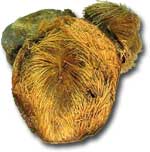
Originally the musk was obtained from the male musk deer. The internal pouches found between the hind legs had an intesely smelling secretion. To harvest the secretion the animal was hunted. To obtain 1 kilo of musk grains between 30 and 50 animals had to be sacrificed. Musk tinctures were still used in perfumery till about 1979, when musk deers were protected form extinction by the Conention on International Trade in Endagnered species of wild fauna and flora(CITES)

Musky smell refers especially from the smell of the dry-down of the natural musk tincture after the more volatile parts are evaporated and when the more warm, sensual, sweet-powdery tonality comes forward. In 1888 Albert Bauer discovered the nitro musk Musk Bauer. Soon replaced by three other nitro musks that he also discovered: Musk Xylene, Musk Ketone and Musk Ambrette. These musks became really important for the fragrances for the next 50 years.
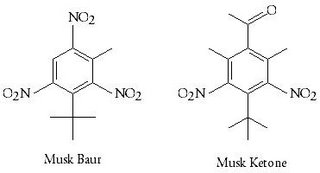

In 1981 the nitro musks were restricted mainly because of a certain toxicity(neurotoxicity) and their phototoxicity, but besides they also caused ecological concerns due to their poor biodegradability. Ernest Beaux the perfumer that created Chanel no5 used over 10% nitro musks in his formulation mainly Musk Ketone. Musk Ambrette was used by the perfumer Francis Fabron for L'air du Temps. These nitro musks had to be replaced by other musk smelling chemicals and that's not an easy thing to do without changing the smell of these perfumes.
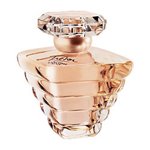

The first nitro free aromatic musk chemical Phantolide was introduced in 1951 by Kurt Fuchs. This was the start of other Polycyclic musks like Celestolide, Fixolide, Tonalide, Galaxolide and many more. Galaxolide was first synthesized in 1965, and already in the late 1960s used in dosages up to 40% in fabric softeners such as Comfort and Soflan and in detergents like Coral at 27%. But high doses were also incorporated in fine fragrances, for instance Tresor by Sophia Grosjsman with its 21,4% of Galaxolide. Galaxolide possesses a clean sweet musky flowery woody odour.

There is another group of chemicals with a musk odour: Macrocyclic musks. Examples of macrocyclic musks are Exaltolide, Habanolide, Velvione and others. Habanolide has a metallic character which is used in Emporio Armani white for her by Alberto Morillas as a component of a white musk accord together with Helvetolide. In Glow by J Lo it's used in an intense white flower accord.
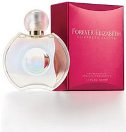
Nirvanolide a chemical produced by Givaudan has a clean and sweet, powdery and persistent, and slightly animalic odour and is quite close to the restricted Musk Ketone. It's used at 6,7% in the perfume Forever Elizabeth created by David Apel. Another chemical with an odour close to Musk Ketone is Muscenone it possesses a very elegant and diffusive musk odour.

Musk odours could also be obtained in the plant kingdom like Angelica root oil that possesses the musk odour Exaltolide(macrocyclic) but also 12-methyl-13-tridecanolide. The discovery of 12-methyl-13-tridecanolide in Angelica root oil was really important because it showed the importance of the effect of methyl substituents on the character of macrocyclic musks. Ambrette seed oil possesses Ambretollide. When thinking about musky smells you don't think about Galbanum because it has a green note with balsamic nuances and isn't musky at all, but the isolated methyl macrolides: 14-pentadecanolide and the 15-hexadecanolide do have a musky odour.

This information I found in the books Chemistry and Technology of flavors and fragrances by David J. Rowe and Perfumery practice and principles by Robert R. Calkin and J. Stephen Jellinek. The picture of the musk pods is from http://www.kogado.co.jp/ the picture of the chemical structures is from http://www.chm.bris.ac.uk/webprojects2003/teo/realmusks.htm the picture of Tresor is from http://www.beautymarkcorp.com/ and the one of Forever Elizabeth is from http://www.fragrancenow.com/

Friday, May 19, 2006

My love for Galbanum

Almost every perfume I like contain the beautiful note of Galbanum. Like Chanel no 19, Must de Cartier, Vent Vert, Cabochard etc. I love the fragrance of it. It's a green soft warm note and used in perfumes to make it more natural and give them a leafy green note. The perfume Vent Vert by Balmain is famous because of the big amount of Galbanum. The perfumer Germaine Cellier used Galbanum on a different way as the other perfumers did. She didn't used it to compliment the other notes but used the Galbanum as a part of the whole fragrance. She used a big amount of the Galbanum like no one ever did before. Galbanum is lovely in combination with Hyacinth but also with Muquet kind of fragrances. It will give a natural green feeling to perfumes. Like in Must de Cartier it's perfect in oriental fragrances as well because of the warm green smell that contain some balsamic notes. But it's also used in Fougere and Chypre perfumes, it's a perfect note to combine with almost everything.

Tuesday, April 04, 2006

Tuberose

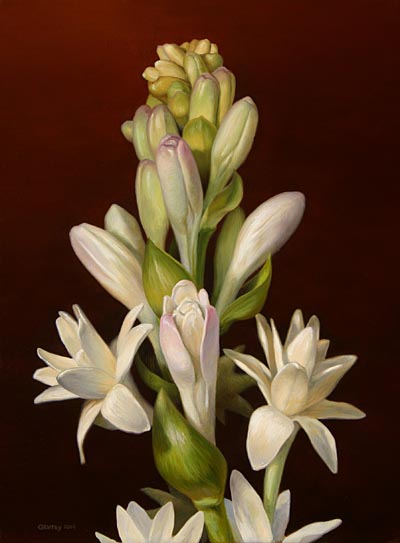
You love it or you hate it, and I just love it. Tuberose or Polianthes tuberosa has a complex scent that reminds me a bit of Jasmine, Narcissus, Ylang Ylang and Gardenia but has more layers. It starts with green notes reminding of sappy green leaves. But it has also some sweet honeylike notes, fatty sultry notes, spicy notes reminding of Clove and even a note that smells like coconut. The fragrance is sultry, sensual, sweet, heady, heavy and intoxicating. Originally the Tuberose comes from Mexico but now it grows in France, India, Marocco and Egypt. It has fragrant waxy white flowers that gives their fragrance at night. A concrete and absolute is extracted by solvent extraction from the fresh flowers, picked before the petals opened. The absolute is more expensive than his weight in gold. I reed once that the smell has similar notes like the scent of the vulva of a woman and even the smell of sweat. The important components of Tuberose are: Methylsalicylat, Methylanthranilate, Methyl benzoate, Benzyl benzoate, Eugenol, Geraniol, Nerol, Farnesol and Benzyl alcohol. I have an old German book of Fred Winter(1942) where he gives a formula of a Tuberose scent:

Methylanthranilat 2 gram
Methylsalicylat 8 gram
Methyllaurinat 6 gram
Methylnonylacetaldehyde 0,1 gram
Benzyl acetaat 1,5 gram
Jasmine artificial 1,5 gram
Coumarin 1,5 gram
Citral 1 gram
Peru balsam 2 gram
Benzyl alcohol 20 gram
Tubrose absolu 10 gram
Jasmine absolu 3 gram
Cassie absolu 1 gram
Ylang ylang 0,5 gram

I like to combine the Tuberose with Oakmoss, Verbena, Jasmine, Orangeblossom, Tolu balsam, Ylang Ylang, Benzoin, Rose, Palmarosa, Rosewood and Mimosa.

The beautiful painting of the Tuberose is from Kitgentry.com